
Watch a top-level match today and you'll hear commentators drop the word "gegenpressing" within the first ten minutes, usually right after a team loses the ball near the opponent's box and swarms it back within two seconds. It sounds like a buzzword, but it's actually one of the most specific and coachable tactical ideas in modern football. Once you know what to look for, you'll spot it in almost every match you watch, from a Bundesliga fixture to a Sunday league game where the manager clearly watched too much Jürgen Klopp on YouTube.
This piece breaks down what gegenpressing actually means, where it came from, and the visual cues that let you identify it live without needing a tactics board or a slow-motion replay. By the end, you should be able to turn to whoever you're watching the match with and say "that's gegenpressing" with some confidence, and actually be right.
What Gegenpressing Means
Gegenpressing is a German compound word that translates roughly to "counter-pressing." The idea is simple on paper: the moment your team loses possession, instead of retreating into a defensive shape, you immediately press the opponent to win the ball back before they can organize an attack. It's an offensive mindset applied to a defensive moment.
The logic behind it is about exploiting disorganization. When a team wins the ball, its players are often still in attacking positions, spread out and thinking forward, not backward. If you press them in that split second, you're attacking players who aren't mentally or physically set up to defend. This is different from a team that loses the ball and calmly drops into a low block, conceding territory to regroup.
There's a specific window this works best in. Most coaches who teach gegenpressing talk about a five-second rule, sometimes stated as six seconds depending on the club. If the ball isn't won back within that window, the team abandons the press and falls into its normal defensive shape instead of chasing a lost cause. That time limit matters because chasing indefinitely burns energy without reward.
The Origins in German Football
The term is closely associated with Jürgen Klopp, who popularized it during his time at Borussia Dortmund between 2008 and 2015, and later brought it to Liverpool. But Klopp didn't invent the underlying concept from nothing. Elements of it trace back to earlier German and Dutch pressing schools, including Rinus Michels' Total Football philosophy in the 1970s, which emphasized compact space and quick reactions to loss of possession.
Klopp's specific contribution was turning it into a structured, drillable system rather than a vague principle. At Dortmund, he trained his players to identify the exact moment the ball changed hands and react as a unit, not as individuals. His 2011 Bundesliga-winning Dortmund side is often cited as the clearest example, particularly their performances against Bayern Munich, where they'd win the ball high up the pitch and score within seconds of a turnover.
Ralf Rangnick is another name worth knowing here. He was developing similar pressing ideas at Hannover 96 and later Schalke and RB Leipzig around the same period, and many credit him as the intellectual godfather of the German pressing movement. Rangnick has said in interviews that he was influenced by watching Arrigo Sacchi's AC Milan in the late 1980s, which used aggressive zonal pressing without the internet-era language to describe it.
The style spread quickly through the German coaching pipeline because the Bundesliga has a culture of coaches studying and borrowing from each other openly. By the mid-2010s, gegenpressing wasn't a Dortmund quirk anymore, it was a recognized school of thought taught in coaching licenses across the country.
Key Triggers to Watch For
Gegenpressing isn't random chasing. Coaches drill specific triggers that tell players when to press instead of retreat. Recognizing these triggers is the fastest way to identify the tactic while watching live.
- The pass is played backward or sideways under pressure. This usually signals the receiving player is uncomfortable, making it a good moment to close in.
- The ball recipient has their back to goal. A player receiving with their back turned can't see the press coming and needs extra touches to turn, giving defenders time to close the gap.
- A heavy or loose first touch. If the ball bounces even slightly away from the receiver's feet, nearby players are coached to sprint immediately rather than wait.
- Numerical overload near the ball. If three or four of your players are already close to the point of loss, that's the trigger to swarm rather than scatter.
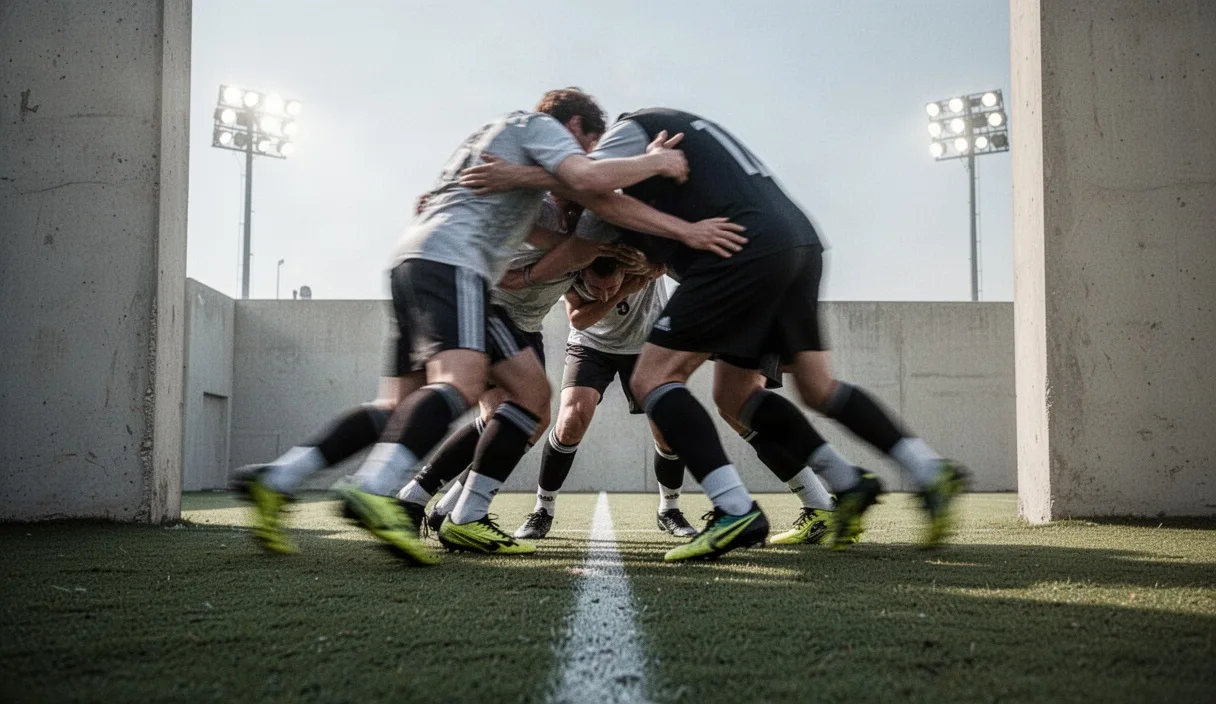
Watch the players nearest the ball in the moment possession changes. In a genuine gegenpressing team, you'll typically see two to three players converge on the ball carrier within about two seconds, cutting off passing lanes rather than just chasing the ball itself. That's the visual tell: it's coordinated, not chaotic.
How It Differs From Regular Pressing
All pressing involves trying to win the ball back, but not all pressing is gegenpressing. The distinction is about timing and location, not intensity.
| Feature | Gegenpressing | Standard High Press |
|---|---|---|
| Trigger moment | Immediately after losing possession | Applied continuously when opponent has the ball, regardless of how they got it |
| Location on pitch | Wherever the ball was lost, often in the attacking third | Usually structured around a fixed defensive line, e.g. pressing from the halfway line |
| Time window | Roughly five to six seconds, then drops off | Sustained for as long as the team maintains its defensive shape |
| Player positioning before the press | Attacking shape, players already forward | Set defensive or midfield block |
A team like Atlético Madrid under Diego Simeone has historically pressed hard, but often from a settled mid-block rather than as an instant reaction to turnovers deep in the opponent's half. That's high pressing without being gegenpressing in the strict sense. The Klopp version is specifically reactive and tied to the exact second the ball is lost.
Teams Known for This Style
Beyond Klopp's Dortmund and Liverpool sides, several clubs have built identities around this approach, each with slightly different flavors.
- Liverpool (2015-2023, under Klopp): Their front three of Mohamed Salah, Roberto Firmino, and Sadio Mané in the late 2010s were drilled to press as a coordinated triangle, cutting off central passing options first.
- RB Leipzig: Under Rangnick and later Julian Nagelsmann, Leipzig used gegenpressing principles combined with extremely fit, young squads capable of repeating high-intensity sprints.
- Bayern Munich under Hansi Flick (2019-2021): Their treble-winning 2020 season featured relentless counter-pressing, most visibly in an 8-2 demolition of Barcelona where turnovers were punished almost instantly.
- Borussia Mönchengladbach under Marco Rose: A less famous example, but Rose's teams in the late 2010s were textbook in their trigger recognition, especially pressing wide fullbacks receiving square passes.
It's worth noting that gegenpressing is physically demanding, which is why it tends to show up more in teams with younger legs or rotation-heavy squads. A team that plays this way every match for a full season without squad depth usually sees a dip in intensity by March or April, which is a pattern you can actually track by comparing a team's pressing success rate in the first half of the season versus the second.
Spotting It in Real Time
Here's a practical sequence to follow the next time you're watching a match and want to confirm whether a team is gegenpressing.
- Watch for the moment of turnover, not the buildup before it. The tactic only exists in reaction to losing the ball.
- Count how many defenders converge on the ball within the first two to three seconds. One player chasing is just hustle, three players closing in a triangle is a system.
- Check whether passing lanes are being cut off, not just the ball carrier being chased. Good counter-pressing blocks the easy outlet pass, forcing a rushed or backward ball.
- Note what happens after roughly five seconds if the ball isn't recovered. A gegenpressing team will visibly disengage and reform a defensive shape rather than keep sprinting individually.
- Look at where this happens on the pitch. If it's consistently happening in the attacking third rather than the middle third, that's a strong signal of intentional counter-pressing rather than generic defensive effort.
A useful shortcut: watch the team's center-backs during a turnover. In a well-drilled counter-pressing side, the back line doesn't panic and push forward chaotically, it holds its shape while the front players do the pressing, ready to step up only if the ball is actually won back.
Common Mistakes
The biggest mistake casual viewers make is calling any hard defensive effort "gegenpressing." A single player winning a 50-50 ball through hustle isn't the tactic, it's just good individual defending. The tactic requires the coordinated, timed group reaction described above.
Another mistake is assuming gegenpressing means pressing everywhere, all the time. It's specifically tied to the moment of losing the ball. A team can play a low, patient defensive block for 90 minutes and still counter-press in short bursts right after turnovers, the two aren't mutually exclusive.
Finally, don't confuse fitness levels with tactical intent. A tired team failing to press isn't abandoning gegenpressing as a philosophy, they're just physically unable to execute it in that moment. Distinguishing between a tactical choice and a fitness limitation takes a bit of practice watching full matches rather than highlight clips.
Next Steps for Watching Smarter
If you want to get sharper at spotting this live, start with a single match and focus only on turnovers for the first 15 minutes, ignoring the rest of the buildup play entirely. Rewatch that same clip once with sound off to focus purely on player movement and spacing.
From there, try comparing two contrasting teams in the same league, one known for counter-pressing and one known for a settled low block, and watch how differently they behave in the three seconds after losing the ball. Over a few matches, the pattern recognition becomes automatic, and you'll find yourself calling it out loud before the commentator does.